
Ladder safety for decorators (INDG401)
At a Glance: Why Painting RAMS Get Rejected?
- Mismatch: Using generic construction templates for specific painting tasks.
- Access: Listing equipment (towers/scaffolding) that isn’t actually on site.
- Relevance: Including hazards irrelevant to painting and decorating.
- Solution: Use specific painting and decorating risk assessments that match the site conditions.
The paperwork versus the van check
It is 7:30 AM. You are parked outside a commercial refurbishment job, boot open, ready to start the prep work. The site manager walks over, clipboard in hand, and asks to see your RAMS. He glances at the document, looks at the stepladder in the back of your van, and hands the paperwork back.
“You can’t start,” he says. “Your method statement says you’re using a mobile tower, but you’ve only brought steps. And this risk assessment talks about brick dust. Come back when the paperwork matches the job.”
This happens every day. Competent decorators lose hours or entire mornings not because they don’t know how to paint safely, but because their paperwork describes a completely different job.
The problem with generic templates
The issue here is rarely a lack of skill. Most professional decorators know exactly how to set up a safe workspace. The problem lies in the documentation systems used to describe that work.
Standard safety templates are often built for large-scale construction projects. They try to cover every eventuality, from excavations to heavy plant machinery. When a painting contractor downloads a generic template, they often end up with forty pages of hazards that have nothing to do with painting a hallway.
This creates a mismatch. The site manager sees a document full of irrelevant risks and assumes you haven’t actually planned the specific job in front of you.
What RAMS are actually for
At its core, a risk assessment for painting works is just a practical plan. It tells the site management team two things:
- Risk Assessment: What might go wrong (e.g., spilling paint on a carpet, falling off a ladder, fumes in a confined room).
- Method Statement: How you are going to do the work without those things happening.
It is not a legal essay. It needs to be a clear instruction set for the specific site you are walking onto.
When access RAMS are requested
Access-related RAMS are commonly requested when the decorating involves:
- Working above normal reach height
- Occupied or partially occupied buildings
- Shared work areas with other trades
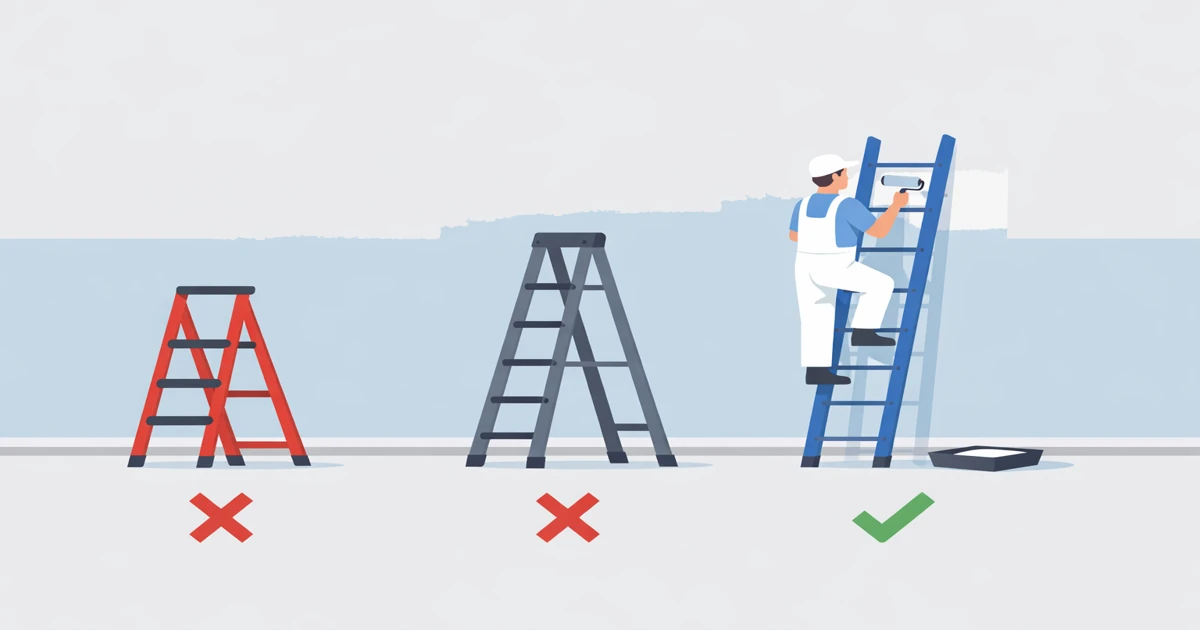
- Visible use of steps, A-frames, or leaning ladders
In most cases, the site manager is not looking for volume. They want reassurance that the access equipment has been chosen properly for the task and the environment.
Routine painting tasks
Most painting jobs fall into a predictable routine. The paperwork should reflect this simplicity. We are talking about:
- Interior emulsion and glossing
- Surface preparation (sanding, filling, cleaning)
- External masonry painting at low levels
- Window frame preparation and painting
- Using water-based or standard solvent-based paints
If the job involves these standard tasks, the paperwork should be straightforward. It does not need to cover heavy demolition or structural alterations.
Why access RAMS get rejected
Rejection usually comes down to trust. Site managers do not trust paperwork that contradicts what they can see on site.
Site managers start asking questions when the document lists access equipment that is not being used, includes hazards that are not present, or relies on generic statements copied from elsewhere. When the obvious details are wrong, everything else gets questioned.
A short document that clearly states how access is being used on that job is more credible than a long one trying to cover every possibility.
Where routine work ends
There is a clear professional boundary with decorating access.
If the task requires repeated overreaching, extended time without moving, poor footing, or any situation where access cannot be adjusted safely, it falls outside routine decorating work.
Being clear about that boundary shows judgement. It avoids forcing unsuitable work into paperwork that was never meant to cover it.
⚠️ Professional Boundary: If the work involves sustained overreaching, long periods in one position, unstable surfaces, or conditions that prevent safe repositioning, it is no longer routine decorating work. At that point, the approach needs to change.
The HSE logic on ladders
The Health and Safety Executive (HSE) does not ban ladders. They simply require that ladders are used only when they are the most suitable equipment for the task.
For decorators, this means ladders are acceptable for “short duration” and “light work.” If your risk assessment justifies why a ladder is better than a podium or tower (for example, due to space constraints in a narrow corridor) and confirms the work is short-term, most site managers will accept it. The key is proportionality.
The difficulty of accurate paperwork
Creating specific paperwork for every small job is difficult. A decorator might visit three different sites in a week. One is an occupied office where the main risk is the public tripping over dust sheets. The next is an empty new build where the main risk is uneven flooring.
Rewriting a document from scratch for every job takes time you don’t have. Using the same old document for every job gets you kicked off site. It is a difficult balance to strike manually.
A tool that enforces logic
This is where RapidRAMS operates differently from a template library. It functions as a logic-based tool rather than a text editor.
You enter the specific parameters of the job: the task (e.g., “Glossing door frames”), the tools (e.g., “Step ladder, sanding block”), and the environment (e.g., “Occupied office”). The system then generates the documentation based strictly on those inputs.
The Refusal Logic
Crucially, the system has hard limits. If you try to select “External Decoration” combined with “High-Risk Asbestos Removal,” the system refuses to generate the RAMS. It forces you to acknowledge that high-risk work requires a different level of planning.
The Site Manager Benefit
Because the system strips out the padding, the resulting document is concise. It tells the site manager exactly what you are doing and nothing else. It creates a document that is:
- Specific: It only lists the hazards of painting and ladder use.
- Credible: It uses the correct terminology for ladder classes and usage limits.
- Safe: It prevents you from accidentally signing off on high-risk exclusions.
You still have to check the document and ensure you can work to the method stated, but the drafting process ensures the logic holds up before you print it.
Getting on site faster
The goal of safety documentation is not to fill a folder. It is to get the work approved so you can start earning. By presenting a risk assessment for painting works that is specific, accurate, and free of generic clutter, you demonstrate competence before you even pick up a brush. The site manager spends less time querying your paperwork, and you spend more time on the job.
Create your INDG401 compliant RAMS
Site-ready RAMS without the paperwork headache