
RAMS for Skip and Scaffold Permits (UK Councils)
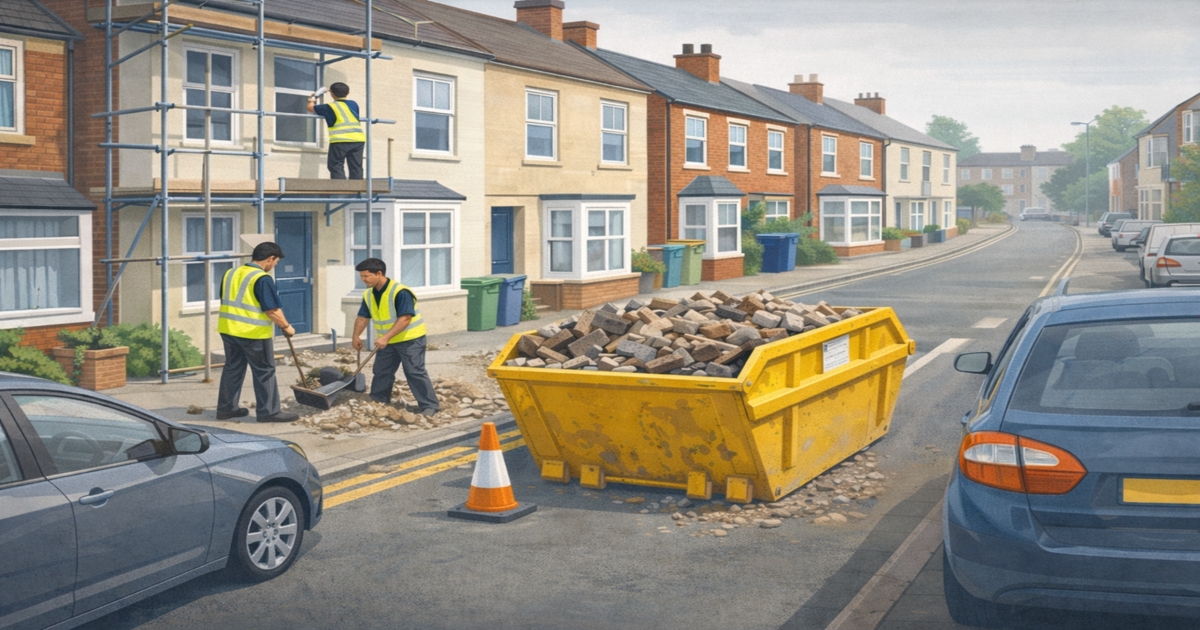
At a Glance: Skips, Scaffolds, and Highway Licences
- The trigger: If a skip or scaffold goes on the road or pavement, a Council highway licence is required.
- The Council’s concern: Highways departments focus on public safety and liability, rather than internal site safety.
- The key test: To pass, RAMS must address visibility (lighting), vehicle protection (cones), and pedestrian access.
- The common failure: Generic building risk assessments are regularly rejected because they fail to mention public highway controls.
- The outcome: Submitting highway-specific RAMS speeds up the approval process by addressing liability concerns upfront.
The driveway problem
You turn up to quote a job. It is a terraced street with on-street parking and a postage-stamp front garden. The client wants a loft conversion or a rear extension.
You know immediately that you cannot get the materials in the garden, and you certainly cannot get a skip on the driveway. It has to go on the road.
You ring the skip company. They ask: “Have you got the permit?”
You ring the Council. They say: “We need to see your public liability insurance and your risk assessment.”
Suddenly, a simple logistics problem becomes a paperwork hurdle. If you cannot provide the right documents, the Council refuses the permit. No permit means no skip. And without a skip, you are hand-balling rubble into a van for three weeks.
“No permit means no skip. And without a skip, you are hand-balling rubble into a van for three weeks.”
Why the Council cares
To a builder, a skip is just a metal box. To the Council Highways Department, it is an obstruction.
Under the Highways Act 1980, the local authority is responsible for keeping the roads and pavements safe. If a cyclist hits your unlit skip in the dark, or a pedestrian trips over a scaffold leg, the Council can be held liable if they issued a permit without checking you knew what you were doing.
From their side, it’s about liability, not red tape. They are checking that you understand the rules of the road.
What the paperwork must show
A standard “building works” risk assessment doesn’t answer the questions they’re asking. The Council does not care about your dust masks or your steel toe caps. They care about the public.
A specific risk assessment for placing a skip on the road needs to answer three main questions:
- Visibility: How will drivers see the obstruction at night? (e.g., Amber flashing lamps attached to the corners).
- Protection: How will you stop cars hitting it? (e.g., Traffic cones placed on the approach).
- Pedestrians: How will people walk past? (e.g., Maintaining a clear, unobstructed pedestrian route on the pavement.).
If your document does not mention lighting or cones, it is likely to be rejected.
What the Council actually checks
The “General Builder” blind spot
For general builders, this is often a blind spot. You are used to managing the site inside the boundary line. Stepping outside that line onto public land brings a different set of risks.
Many builders assume the skip company sorts the permit. While some do, many local authorities now insist that the contractor applies for the licence because the contractor is the one filling the skip.
The same applies if you need a method statement for working on public highway areas, such as putting up hoarding or a scaffold tower. The method statement needs to describe how you will build the structure without dropping a clamp on a passerby.
Common reasons for rejection
When applying for a licence, speed matters. You usually want the permit to start Monday. If the Council rejects your RAMS on Thursday, you are stuck.
Common failures include:
- Missing dates: Not stating when the obstruction will be removed.
- No lighting plan: Failing to mention battery-operated amber lamps.
- Blocking the path: Not leaving enough room for a wheelchair or pram to pass safely.
- Wrong template: Sending a generic risk assessment for internal joinery when you need RAMS for a pavement licence application.
The person reviewing your application is likely a Highways Officer. They look for clear references to signage, lighting, and pedestrian protection. If those controls aren’t present, applications often stall.
Why applications get stuck
A system built for permits
This is where RapidRAMS helps you clear the hurdle. Instead of asking you to write a traffic management plan from scratch, the software reacts to a simple choice.
You simply confirm that the skip or scaffold is going on a public highway. The software links the correct safety controls to that answer. It pulls in the requirements for amber flashing lights, traffic cones, and pedestrian clearance widths without you needing to type them out.
Because the system builds the Highway rules into the document, the resulting risk assessment for a skip licence speaks the Council’s language. It confirms you have considered the public, the traffic, and the lighting.
Getting the permit signed off
The goal is to get the box ticked so you can get on with the build. By submitting a professional, specific document that addresses the Highway concerns upfront, you make it easy for the Council to say yes.
You get your permit, the skip arrives on time, and you aren’t left hand-balling bricks.
This guide forms part of our Knowledge Hub, covering real-world RAMS requirements for UK contractors working on managed sites.
Stop permit delays before they start
Task and site-specific RAMS without the guesswork